Skip to content
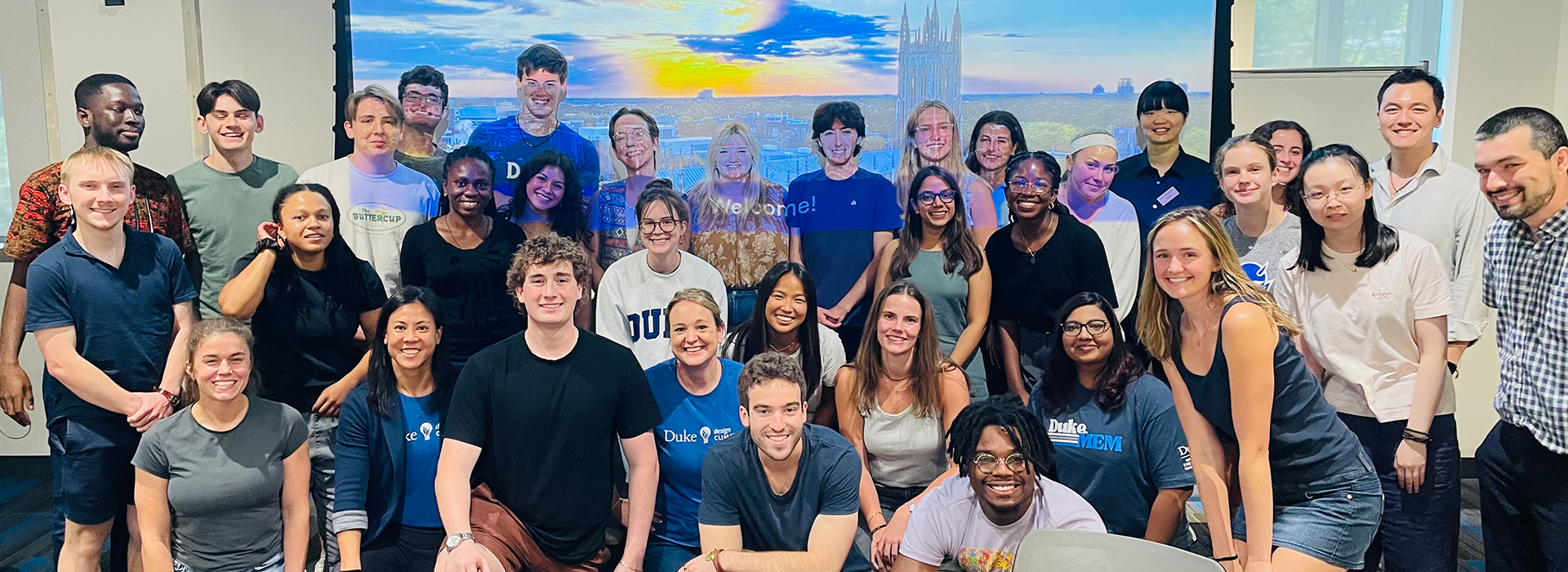
students in front of projector screen

Courses

Design Climate Course Sequence

Through Design Climate’s two-semester course sequence, students (undergraduates and graduate students) investigate triple bottom line climate-tech business ideas that generate positive environmental, societal, and financial return. Over the year, students conduct customer discovery interviews, learn entrepreneurship and business principles, prototype, practice pitching, and much more. Student teams meet regularly with founders and mentors who guide their work. While Design Climate focuses on startup development, the entrepreneurial skills developed are valuable trainings for leaders in any future career.

Design Climate I: Discover

Design Climate I focuses on evaluating a climate and sustainability-inspired business idea using a customer discovery process. These business ideas are generated from Duke faculty or industry partners. Students then work through the first three phases of the design thinking process: stakeholder empathizing, opportunity definition, and solution ideation. The goal of Design Climate I is to 1) identify a product that meets the needs of a beachhead market that has a $20-$100M/year total addressable market size, and 2) develop a prototyping plan for how this product idea can be tested in Design Climate II. The semester culminates with a mini pitch of the startup business idea and a preliminary proof-of-concept prototype that will be further vetted in Design Climate II.

Design Climate II: Develop

The spring semester focuses on getting customer feedback on the product idea developed in Design Climate I and building a business model around the idea. Students continue to use the design thinking framework to prototype, test, and iterate on their ideas as well as build out their business model with financial projections. By the end of the semester, students will have validated their business idea, and the semester will culminate in a pitch and video presentation to members of the local entrepreneurship community.

Eligibility
  • Each team is typically comprised of graduate students and upper-level undergraduates from: The Pratt School of Engineering, The Nicholas School of the Environment, students pursuing an Innovation & Entrepreneurship (I&E) Certificate, and students with an interest in energy and climate technology.
  • No prerequisites are required except for a willingness to learn new skills.
  • All prospective participants should be willing to commit 6-10 hours each week and commit to taking both semesters—Design Climate I and II.
  • Students may work with instructors to propose business ideas for Design Climate.
How to Integrate Design Climate into your Degree Program and Enrollment Instructions

Follow the steps below to join this program. Please only sign up for Design Climate I if you intend to take both semesters of Design Climate.

  • Register on DukeHub for Design Climate I: Discover (ENG 545, ENVIRON 545, or I&E 545) in the fall and Design Climate II: Develop (ENG 546, ENVIRON 546, or I&E 546

The Design Climate course sequence can integrate into a variety of degree and certificate pathways. See below for existing options. If you would like to integrate Design Climate into your degree program, please reach out to the instructors over email or the Contact Us page and we will work with your department to develop pathways for Design Climate to count towards your degree requirements.

  • If you are a Mechanical Engineering Undergraduate, you can also take Design Climate for Mechanical Engineering Credit as a 490 Special Topics class.
  • Economics students can take Design Climate II for a financial markets (FMKT) credit
  • If you are an incoming Masters of Engineering Management student, you may have a cohort and/or seminar conflict. If you want to take Design Climate, contact Design Climate through the Contact Us page, and we will help navigate cohort assignments and program seminar scheduling.
  • Design Climate II can count as a replacement for MEng 570: Business Fundamentals for Engineers for engineering programs.
  • Nicholas School of the Environment Masters students can use Design Climate as their Master’s Project capstone class
  • Nicholas School of the Environment undergraduates can use Design Climate courses as a capstone class and focus area requirement when taking both semesters of Design Climate
  • Energy and Environment Certificate students can take Design Climate courses as an Energy Science and Technology elective and free elective.
  • Design Climate can often count as an upper-level engineering elective. Contact instructors for more information

Climate-tech Studio Course

Track, measure, and change the world. In this climate tech product design course, your team will build devices to help reduce carbon emissions, water usage, or waste production to adapt to climate change or protect ecosystems. From AI usage counters to water flow sensors or waste trackers, you’ll uncover a real need, test and validate it, prototype, iterate with real data, and present your solution in a final design showcase. Along the way, you’ll sharpen your technical, design, and systems thinking skills – learning how to bring climate-tech from idea to impact. 

Climate-Tech Studio immerses engineering and arts & sciences students in climate-tech product design. Students will build devices that track, measure, and/or change resource consumption or waste generation on campus (e.g. AI energy counters, water usage monitors, waste flow sensors). Working in interdisciplinary teams, students begin by deeply investigating and validating a real campus-scale problem, then rapidly move into design, prototyping, testing, and iteration.

Together, we’ll investigate:

  • How can technology help reduce carbon emissions, water usage, and/or waste production to adapt to climate change or protect ecosystems?
  • How can we evaluate a process to quantify and determine a real problem and develop solutions?
  • What does it take to move from an idea to a physical or digital prototype that has real-world impact?
  • How can design, engineering, and entrepreneurship intersect to create scalable solutions for climate action?

Deliverables include a polished prototype or deployable plan, an ePortfolio capturing the design journey and data insights, weekly reflections, and a final showcase. Collaboration, accountability, and iterative feedback are built into the course structure to support high-quality outcomes and scalable thinking.

This course matters because the climate crisis is one of the defining challenges of our time—and creative, tangible solutions are urgently needed. By working at the intersection of design, technology, and sustainability, you’ll not only develop technical skills in prototyping but also learn how to apply them toward meaningful climate impact. Climate-tech Studio fits into a larger ecosystem of courses and initiatives focused on innovation for climate resilience. It complements classes in design, engineering, and entrepreneurship while giving you a unique space to test, tinker, and bring your ideas to life in the service of the planet.

No prior prototyping experience is required—just bring a curious mind and a willingness to explore.

student working on an electronic device